
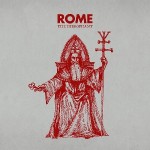
With “The Hierophant,” Jerome Reuter, the creative mind behind the Luxembourgish neofolk project Rome, presents a work that rises like a dark sermon from the depths of European history and human abysses. After more than two decades and over twenty studio albums, Reuter proves once again that he is one of the most important voices in contemporary neofolk and dark folk – an artist who never rests on his laurels, but constantly explores new thematic and musical territories.
The title “The Hierophant” refers to the fifth card of the Major Arcana in the Tarot – the high priest, the mediator between the divine and the profane, the guardian of hidden wisdom. This symbolism runs through the entire album like a red thread. Reuter presents himself here as a modern hierophant, guiding listeners through a labyrinth of religious symbolism, historical traumas, and existential questions. As usual, the lyrics are of the highest literary quality. Reuter weaves references to Christian mysticism, pagan traditions, and the dark chapters of European history into a dense web of meaning. In doing so, he skillfully avoids the pitfalls that many other artists in the genre fall into: his historical references are never nostalgically romanticized, but always critically reflective. The past is not romanticized, but used as a mirror of current human conflicts.
Musically, “The Hierophant” presents itself as one of the most multi-layered albums in Rome’s discography. The production strikes a remarkable balance between the intimate, spartan aesthetics of Rome’s early works and the orchestral arrangements of his later releases. The acoustic guitar remains at the heart of Rome’s sound—Rome’s characteristic fingerpicking, reminiscent of dark campfires in war-torn landscapes, is more present than ever. But it is complemented by string arrangements reminiscent of Ennio Morricone’s Western soundtracks, by martial industrial elements that are used discreetly but effectively, by choral passages that evoke sacred atmospheres, and by electronic textures that never push themselves to the fore but lend subtle depth.
Jerome Reuter’s baritone has gained depth and expressiveness over the years. On “The Hierophant,” he varies between whispering intimacy, proclamatory pathos, and melancholic vulnerability. His phrasing is reminiscent of Leonard Cohen, Nick Cave, and David Eugene Edwards in places—without ever seeming derivative. The way he emphasizes individual words, how he pauses and stretches syllables, testifies to a singer who has complete mastery of his instrument and whose voice itself becomes a meaningful element.
The album opens with a trilogy that introduces the listener to the thematic world. The first notes—a single, echoing guitar chord overlaid with distant bell ringing—immediately establish the sacred atmosphere. The opening track functions like the introit of a black mass, preparing the ground for what follows. The middle of the album contains what are perhaps the most accessible pieces, showcasing Reuters‘ mastery of musical historiography. As on masterpieces such as “Flowers from Exile” or the “Die Æsthetik der Herrschaftsfreiheit” trilogy, he succeeds in setting historical events to music in such a way that they unfold with immediate emotional force without slipping into historical distortion or pathos. The closing tracks form a worthy conclusion, ending the album not in false hope or cheap despair, but in a kind of stoic acceptance of the human condition.
The production of “The Hierophant” deserves special mention. The album sounds organic and warm without completely rejecting the lo-fi aesthetic typical of the genre. The dynamics are remarkable: quiet passages are allowed to breathe, loud moments unfold with physical force without distortion due to compression. The spatial design creates a kind of acoustic cathedral—you feel like you’re sitting in a large, reverberant room while the music surrounds you. This perfectly supports the thematic focus: the listener becomes a believer in an unknown temple.
In the context of Reuters‘ work, “The Hierophant” marks an interesting position. After the stylistically diverse experiments of recent years—the forays into chanson territory, the approaches to alternative rock—this album seems like a conscious return to the core competencies of the project. At the same time, it is not a nostalgic work. The maturity that Reuters‘ songwriting has achieved is palpable in every bar. The arrangements are more complex than in his early works, the thematic depth even more pronounced, the emotional range greater. You can feel the dark intensity of “Masse Mensch Material,” the lyrical density of “Flowers from Exile,” the spiritual quest of “The Lone Furrow,” and the musical sophistication of “Le Ceneri di Heliodoro”—all combined and yet formed into something new.
The album has numerous strengths. Reuters‘ lyrics are among the best the genre has to offer – intelligent, multi-layered, never simplistic. The album creates an immersive sound experience that completely captivates the listener. Despite the often dramatic gestures, the music never seems calculated or manipulative; the emotional authenticity is palpable at all times. The sound production is flawless and perfectly supports the artistic vision, and the album functions as a total work of art in which the tracks form a well-thought-out dramaturgy.
Despite all the admiration, there are also some critical points to mention. Like many Rome albums, “The Hierophant” requires intensive engagement, and casual listeners may find its density overwhelming. Those who are not familiar with neofolk will not find access here either, as the album makes no compromises. At over 50 minutes, the album is quite demanding, and some passages might have benefited from tighter editing. However, these are objections that do little to detract from the overall impression.
“The Hierophant” is an album that takes its listeners seriously—perhaps more seriously than some would like. It is not a background album, not light fare, not a work for in between. It demands attention, dedication, and a willingness to engage with uncomfortable questions. For those who are willing to do so, “The Hierophant” is an extraordinary listening experience. Jerome Reuter proves once again that he is one of the most important songwriters on the European music scene – an artist who carries on the torch of the great dark romantics without ever resorting to mere imitation. The album is a worthy addition to an oeuvre that is already among the most remarkable in contemporary music. The Hierophant has spoken – those who have ears to hear, let them hear.
Fans of Death in June, Current 93, Nick Cave, Leonard Cohen, Sol Invictus, Spiritual Front, and King Dude will find plenty to enjoy here, while listeners seeking immediate accessibility and catchy melodies may find it less appealing. “The Hierophant” is more than an album—it is an invitation to contemplation, a meditation on history, faith, and the dark corners of the human soul. In an age of superficial musical arbitrariness, it is a statement for depth, meaning, and the uncomfortable beauty of art.