
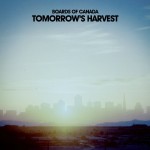
Tomorrow’s Harvest is not an album that tries to ingratiate itself. It is a work that keeps the listener at a distance, observing them rather than embracing them. And that is precisely where its quality lies: in 2013, Boards of Canada presented a late work that is less of a return than a redefinition – darker, more sparse, and conceptually more rigorous than anything they have released before.
After the warmly shimmering “Music Has the Right to Children” and the more dreamy “The Campfire Headphase,” “Tomorrow’s Harvest” seems like a dampening of their own universe. The familiar analog patina is still there – the tape noise, the slightly out-of-tune synths, that peculiar, grainy texture that sounds like watching old educational TV recordings on worn-out VHS tapes. But the mood has shifted: where childlike nostalgia and psychedelic transfiguration once dominated, here there is an apocalyptic diagnosis, a ghostly emptiness, and a feeling of technical, ecological, and social overstimulation.
The opening tracks, “Gemini” and “Reach for the Dead,” already define this new direction. The harmonies are still melodic, but they seem “depopulated”—as if the happy images had been removed from memory, leaving only the background noise of the world.
The rhythm is subdued, almost stoic, more pulse than beat. Again and again, echoes of soundtrack music from the late 70s and early 80s emerge: Vangelis, John Carpenter, early nature documentaries, cold surveillance aesthetics – all of this seems to seep through the cracks of the soundscape.
Instead of clear song structures, there is a sequence of vignettes, fragments, miniatures. Pieces like “White Cyclosa,” “Cold Earth,” and “Jacquard Causeway” seem like satellite images of a wounded Earth: distant, but fatally concrete. When listening, you can almost “see” the yellowed colors, overexposure, and empty landscapes that the music implies. Boards of Canada work masterfully with hints here: short melodic motifs that are only hinted at; chord changes that deliberately lead into emptiness; rhythms that seem more like machine processes than “groove.”
At the heart of the album is an atmospheric tension between nostalgia and doom. Tomorrow’s Harvest sounds as if someone in the future is looking at archives of a past future – at all the optimistic visions of the future from the 1960s to the 1980s that were seen in commercials, documentaries, and educational programs – and realizing how little of it has come to pass. This meta-perspective makes the album more than just “dark electronica”: it is a meditation on failed promises of the future, on a belief in progress that has turned into disaster scenarios.
What is particularly impressive is how consistently the duo implements this vision in their sound design. The synthesizers often sound like decaying architecture: monumental, but fragile. The soundscapes have something smoggy about them, laying themselves over everything like a milky veil without ever becoming completely clear. The handling of dynamics is also remarkably subtle: the album has hardly any spectacular climaxes, but works with slowly rising and falling arcs of tension that are more cinematic than “song-oriented.” “Palace Posy,” for example, offers one of the most accessible moments, but still remains in this distant, eerie sphere.
In terms of content -as far as one can speak of that with a predominantly instrumental album – it is less about concrete themes than about states of being: surveillance, environmental decay, technocratic coldness, the disappearance of the human from the images. The track titles – “Transmisiones Ferox,” “Split Your Infinities,” “Sundown,” “Collapse” – reinforce this feeling of gradual but inevitable disintegration. The music refuses to offer comfort; it doesn’t comment, it shows.
It is precisely this consistency that could also become a problem for some listeners. Compared to earlier albums, there are fewer catchy motifs, fewer immediately recognizable “hooks.”
Tomorrow’s Harvest is a slow album that unfolds its effect layer by layer. When listened to casually, it can seem uniform, almost hermetic. Much depends on the listener’s willingness to immerse themselves in the atmosphere and accept the absence of classic dramatic arcs as an artistic statement.
As part of Boards of Canada’s discography, the album marks a kind of tipping point: it bundles many of their familiar elements – the analog aesthetic, the fascination with archival images, the broken nostalgia – and drives them in a much more radical, dystopian direction. Those who liked the dark undertones in “Geogaddi” will find something like a consistent continuation here; those who appreciated the warmth and “childhood filter” in “Music Has the Right to Children” may feel less at home in this arid soundscape.
In the context of electronic music of the 2010s, Tomorrow’s Harvest also stands out for its timelessness. While many productions of this era were strongly oriented toward current trends, this album deliberately sounds out of time – not retro in a nostalgic sense, but like an artifact from a parallel past. This peculiar timelessness gives it a longevity that has hardly lost any of its impact even years after its release.
The bottom line is that Tomorrow’s Harvest is an impressively cohesive, visual album – a dystopian film without images that plays out in the listener’s mind. It is less accessible than the classics in Boards of Canada’s catalog, but conceptually sharper and atmospherically denser. Those who are willing to immerse themselves in this barren, poisonously shimmering soundscape will find one of the most mature and resonant works of modern electronic music.