
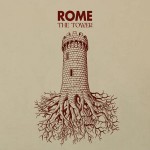
For two decades now, Jerome Reuter has been wandering through the shadow galleries of European history with his project ROME, singing about fallen empires, forgotten ideals, and the eternal recurrence of human tragedies. With The Tower—his eighteenth studio album—he has created a work of such concentrated power that even long-time admirers are left in awe. Here is an artist at the zenith of his creative powers, looking down with a clear eye on the ruins of modernity.
The opening bars of the first track already suggest that this album follows different rules. A single acoustic guitar, plucked almost hesitantly, makes room for Reuter’s voice – that deep, life-scarred instrument that has gained texture and expressiveness over the years like an old cognac gains complexity. Then the strings come in, not bombastically, but gently, like a fog rolling in over autumn fields.
The production of The Tower deserves special mention. Reuter and his team have created a sound that breathes organically yet reaches monumental dimensions. The arrangements move smoothly between folkloric intimacy and neoclassical grandeur, between the sparse beauty of a single trumpet and the overwhelming presence of a full orchestra. Drums and percussion—where they are used—pulse like a weary but persistent heartbeat beneath the melodic layers.
The spatial quality of the recordings is particularly remarkable. You feel as if you are actually inside a tower: sounds echo off stone walls, voices seem to descend from above or emerge from hidden chambers. This acoustic architecture is not merely an effect, but serves to profoundly enhance the emotional impact of the work as a whole.
Jerome Reuter is perhaps the most literate songwriter of his generation, and The Tower shows him at his absolute best. His lyrics have always been rich in allusions, but here they reach a new level of density. One senses Yeats‘ vision of the collapsing gyrus, Ernst Jünger’s contemplative distance, Rilke’s existential urgency—and yet everything remains unmistakably Reuter.
The tower of the title turns out to be a kaleidoscopic metaphor that reveals new facets with each listening. It is the Tower of Babel, symbol of human hubris and divine punishment. It is the ivory tower of the intellectual, both refuge and prison. It is the watchtower of the soldier, the lighthouse of the seeker, the bell tower that calls to prayer or sounds the alarm. In one particularly haunting track, it even becomes a tomb—a vertical mausoleum for buried hopes.
Reuter sings of wars that never end, only change form. Of men searching for meaning in ruins. Of a Europe that has forgotten its own children.
But despite all the gloom, the album is permeated by a strange warmth, an almost defiant tenderness. In The Tower, Reuter doesn’t just accuse—he mourns, and in this mourning lies a strange comfort.
Like a carefully constructed novel, The Tower follows an inner dramaturgy that not only recommends listening to it in one go, but downright demands it. The twelve tracks form an arc from awakening to rise to inevitable fall – and beyond.
The first half of the album establishes themes and motifs, slowly immersing the listener in Reuter’s world. The middle brings the emotional climaxes: orchestral outbursts reminiscent of Ennio Morricone’s most epic compositions, followed by moments of shattering silence. The final third leads through rubble and ashes, finally culminating in a closer that is one of the most beautiful pieces Reuter has ever written – a meditation on transience and survival that lingers long after it ends.
Between the main pieces are instrumental passages and sound collages that serve as thresholds between chapters. Field recordings – wind sweeping around old walls, distant church bells, the crackling of a fire – anchor the abstract in the concrete, the mythical in the everyday.
For connoisseurs of Reuter’s work, The Tower offers numerous references to earlier albums.
Melodic phrases from Nos Chants Perdus reappear in a new form, lyrical motifs from Le Ceneri di Heliodoro find their continuation. And yet this is not a nostalgic album, not a self-citation. Reuter takes up the threads of his previous work and weaves them into a new, larger pattern.
At the same time, The Tower is more open to new influences than its predecessors. There are echoes of Scott Walker’s late experiments, the sublime sadness of Dead Can Dance, the cinematic power of Godspeed You! Black Emperor. A guest singer—whose identity is not revealed in the booklet—lends two tracks an ethereal counterpoint to Reuter’s earthy presence.
It is impossible to listen to The Tower without thinking about the world in which it was created. The multiple crises of the 2020s – geopolitical, ecological, existential – have left their mark on this work. And yet Reuter refuses to make any simple commentary or political commentary. His perspective is that of a historian who knows that this too shall pass, and that of a poet for whom the transitory has eternal significance precisely because of this.
In a musical landscape increasingly dominated by algorithms and the attention economy, The Tower is an anachronistic bulwark. It demands time, dedication, repeated listening. It rewards patience with layers of meaning that only gradually reveal themselves.
In other words, it is exactly what music can be at its best: a portal to other states of consciousness.
With The Tower, Jerome Reuter has not simply presented another album—he has erected a monument. A work that brings together the qualities that have distinguished ROME for over two decades: literary depth, musical beauty, emotional authenticity, and an inimitable ability to make the past shine through in the present.
This is an album for those lonely hours after midnight, when the world comes to rest and the big questions resurface. It is an album for autumn walks through old towns, for leafing through yellowed books, for quietly remembering what was and will never be again. In short, it is a masterpiece.
If The Tower is indeed – as some rumors suggest – Reuter’s farewell work, then this would be a departure of majestic dignity. However, if it is the prelude to a new chapter, then we can look forward with excitement to the heights that are yet to be scaled.
Buy. Listen. Repeat. Marvel.
For fans of: Death in June, Current 93, Nick Cave & The Bad Seeds, Dead Can Dance, Scott Walker, Ordo Rosarius Equilibrio